
Daily Devotions
New devotions are posted Monday, Wednesday, and Friday.
The Towering Confusion
Today’s author is Prince of Peace member, Scott Tunseth.
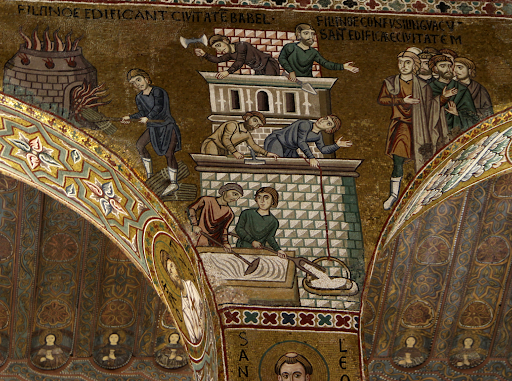
The story of the Tower of Babel in Genesis 11 has (no pun intended) multiple layers of meaning. Take the Hebrew word Babel itself. It is very similar to the Hebrew word balal, which means “to confuse.” Most commentators believe this is an intentional wordplay. According to Terrence Fretheim in Lutheran Study Bible, this might even “be a bit of sarcastic humor aimed at the later Babylon.”
But what or who is confused? Well, the builders want to eliminate confusion by building their tower to the heavens in order to make a name for themselves but also so they won’t be scattered all over the earth (11:4). That doesn’t logically follow, but the words of God clear things up: “they are one people, and they all have one language, and this is only the beginning of what they will do.” The implication is that, like their forebears Adam and Eve, the tower builders want to be like God. But as Pastor Steve has helpfully reminded more than once recently, God is God, and we are not. To be confused about that leads to trouble.
So how does God respond? God says, “Come, let us go down and confuse their language, so they will not understand one another’s speech. And then God scatters them abroad over the face of all the earth, and they stopped building the city and its great tower.
Terrence Fretheim points to another issue with the building of the tower. He claims the builders were challenging God’s command to fill the earth (Gen 1:28), which is necessary in order to be caretakers of the earth. He goes on to say that “God’s action challenges an isolationist perspective and promotes diversity for the sake of the care of the earth and its creatures.”
Commenting on this idea in Working Preacher, Rev. Dr. John Anderson says, “Uniformity, homogeneity, sameness, and siloing is what humanity desires, but it is not an accurate expression of how God wants humanity to inhabit the world God imagines. The scattering of people and confusion of language is not a curse or a punishment. It is God course-correcting the world to be in alignment with what has always been the divine intent and purpose. Toward that end, at Babel God not only blesses and sanctifies diversity⎯God creates it.”
What does this say (if anything) about an administration that wants to delete anything that looks like DEI (diversity, equity, inclusion)? Could there be confusion about what God wants for our world? Could there be confusion about who is God and who is not?
I’ll leave you with those questions.
Merciful God, we give thanks for the rich diversity present in our world. Help us to embrace the other, the one who is not exactly like us, as brother or sister, friend or neighbor, in you. Amen.
Previously…
A Slippery Slope
In Revelation 17, John warns his readers to be cognizant of the evil that is always underfoot. Sometimes we can easily identify it. But often, evil is insidious, creeping into our lives and masking itself as benign, enticing us in ways that make it difficult to resist. And once we start following its path, it can be a very slippery slope, indeed.
Handel’s Messiah
Charles Morris in the article “Handel’s Messiah: Lyrics and Verse References” (Nov 20, 2020) wrote about this great work of music. The Messiah has been a significant work enjoyed by multitudes of people since it was composed in 1741.
Code-switching
Code-switching refers to the way in which people adapt their language and mannerisms to a particular situation. At its worst it flattens cultural and linguistic diversity by forcing members of marginalized groups to adapt to the dominant culture, especially when it is required to achieve success in the workplace (if you’ve ever heard someone say a black person “doesn’t sound black,” this is likely a result of code-switching). It can damage a code-switcher’s sense of self-worth, exclude qualified people from leadership, and disrupt society’s understanding and appreciation of the breadth of experiences and values individuals have.
Exclamation Points
Have you ever read through an email before you send it and thought there were too many exclamation points? (I shouldn’t be that enthusiastic!) Then maybe you take out a few and it seems too flat? (I want to sound professional, not boring.) A few more adjustments and it’s probably okay to send now….right?