
Today as I write this, I’m thinking of my dear friend, Jessica, who is living with a brain tumor. “As brain tumors go,” Jess told me after her diagnosis two years ago, “it is a ‘good’ type to have, but it’s in a ‘very bad’ place.” So when she underwent surgery at Mayo, the doctors took as much of the tumor as they could, leaving the rest because attempting to remove it altogether posed too great a risk.
Jess’s journey has been a difficult one, robbing her of many of the things she has loved doing throughout her life. But she is grateful to still be alive, cherishing the extra measure of time she has been given. A while back, Jess posted the following story on her Facebook page:
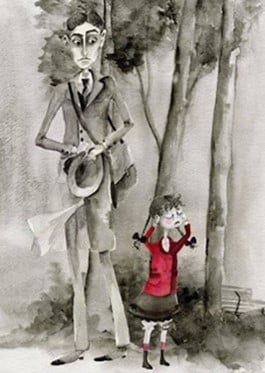
When he was 40, the renowned Bohemian novelist and short story writer, Franz Kafka (1883-1924), was strolling through Steglitz Park in Berlin, when he chanced upon a young girl crying her eyes out because she had lost her favorite doll. She and Kafka looked for the doll without success. Kafka told her to meet him there the next day and they would look again.
The next day, when they still had not found the doll, Kafka gave the girl a letter “written” by the doll that said, “Please do not cry. I have gone on a trip to see the world. I’m going to write to you about my adventures.” Thus began a story that continued to the end of Kafka’s life.
When he and the girl would meet, Kafka read aloud his carefully composed letters of adventures and conversations about the beloved doll, which the girl found enchanting. Finally, Kafka read her a letter of the story that brought the doll back to Berlin, and he then gave her a doll he had purchased. “This does not look at all like my doll,” she said. Kafka handed her another letter that explained, “My trips, they have changed me.” The girl hugged the new doll and took it home with her. A year later, Kafka died.
Many years later, the now grown-up girl found a letter tucked into an unnoticed crevice in the doll. The tiny letter, signed by Kafka, said, “Everything you love is very likely to be lost, but in the end, love will return in a different way.”
The disciples must have felt that all was lost when they saw Jesus’ lifeless body hanging on the cross. Perhaps they remembered that Jesus had tried to prepare them for this moment. But I wonder if, in the midst of their anguish, they were able to recall Jesus’ words that would change everything: he would rise again.
Death always looks like the end. And of course, it is the end of the relationship with our loved one as we have known it. But because the tomb was empty on Easter morning, death never has the last word. Love returns. Love always returns.
Even death cannot match the power of your love, O God. We praise you for the promise of the Resurrection and for your love that holds us forever. Amen.