Today’s author is Prince of Peace member Carol Swanson.
Read Acts 17:16-31.
“We are distant relatives to the stars and kissing cousins with the oceans, plants, and other creatures on the earth,” wrote Sallie McFague in her book The Body of God: An Ecological Theology. Like Paul in Athens finding common ground from which to preach, McFague starts with a telling of the common creation story from science:
“Cosmology joins evolutionary biology, molecular biology, and ecology in showing the interdependence of all things. We are part of an ongoing community of being; we are kin to all creatures, past and present. From astrophysics we know our indebtedness to a common legacy of physical elements. The chemical elements in your hand and brain were forged in the furnaces of the stars. The cosmos is all of one piece. It is multi-leveled; each new higher level was built on lower levels from the past. Humanity is the most advanced form of life of which we know, but it is a part of a wider process in space and time.” (pp27-28, quoting Ian Barbour, Religion in an Age of Science, p 147)
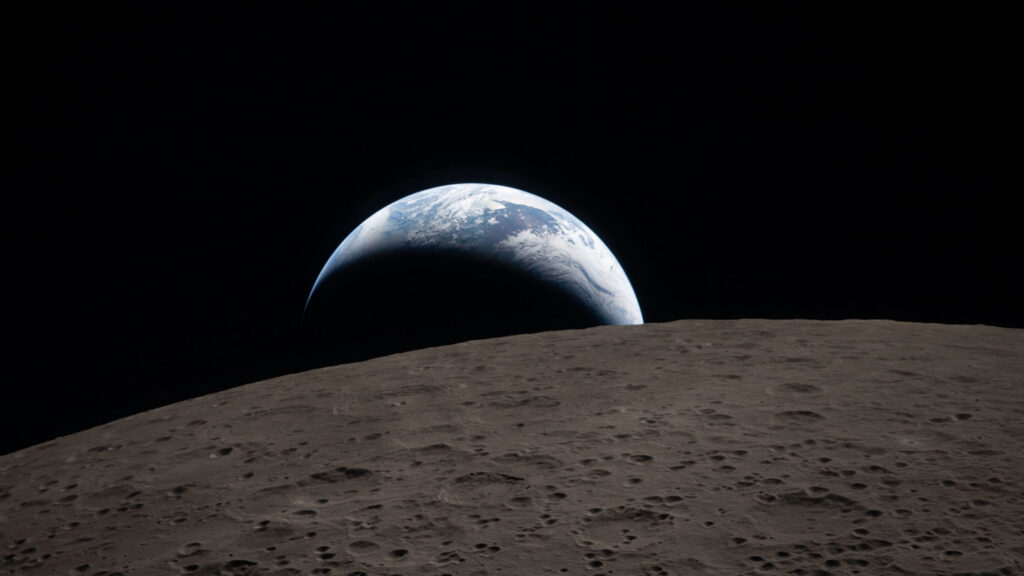
No matter which religion (or no religion) we follow, we all have Earth as our home and the universe that has produced it. World faiths need to come together to care for our earthly home. Let us see the universe and Earth as God’s metaphorical body.
I love her Meditation on Exodus 33: “And you shall see my back; but my face shall not be seen.”
“When Moses in an audacious moment asks of God, ‘Show me your glory,’ God replies that ‘no one can see me and live,’ but he does allow Moses a glimpse of the divine body—not the face, but the back (Exod. 33:20-23). The passage is a wonderful mix of the outrageous (God has a backside?!) and the awesome (the display of divine glory too dazzling for human eyes). The passage unites guts and glory, flesh and spirit, the human and the divine, and all those other apparent dualisms with a reckless flamboyance that points to something at the heart of the Hebrew and Christian traditions: God is not afraid of the flesh. We intend to take this incarnationalism seriously and see what it does, could, mean in terms of the picture of reality from postmodern science. Were we to image “the Word made flesh” as not limited to Jesus of Nazareth but as the body of the universe, all bodies, might we not have a homey but awesome metaphor for both divine nearness and divine glory? Like Moses, when we ask, “Show me your glory,” we might see the humble bodies of our own planet as visible signs of the invisible grandeur. Not the face, not the depths of divine radiance, but enough. We might begin to see (for the first time, perhaps) the marvels at our feet and at our fingertips: the intricate splendor of an Alpine forget-me-not or a child’s hand. We might begin to realize the extraordinariness of the ordinary. We would begin to delight in creation, not as the work of an external deity, but as a sacrament of the living God. We would see creation as bodies alive with the breath of God. We might realize what this tradition has told us, although often shied away from embracing unreservedly: we live and move and have or being in God. We might see ourselves and everything else as the living body of God (pp131-132).
McFague writes of Genesis 1 and 2:
“Spirit, as wind, breath, life is the most inclusive way to express centered embodiment. All living creatures, not just human ones, depend on breath. Breath also knits together the life of animals and plants, for they are linked by the exchange of oxygen and carbon dioxide in each breath inhaled and exhaled…. [T]he dust of the universe enlivened by the breath of God. Each of us, and each and every other part of the body as well, owes our existence, breath by breath as we inhale and exhale, to God. We ‘live and move and have our being’ in God (Acts 17:28). Indeed we do. That is, perhaps, the most basic, physical level. And so does everything else in creation also live, moment by moment, by the breath of God, says our model” (pp143-144).
McFague speaks of the Trinity:
“It is a kind of trinitarian reflection that emphasizes both the mystery of God (the face or “first person”) and the visible physicality of God (the body or “second person”), both the radical transcendence and the radical immanence of God. The mystery and the mud, the invisible and the visible, are mediated by the spirit (“third person”), the dynamic life and breath that moves in all things, Once again, the Christic paradigm will give a particular shape to this reflection: immanence does not mean simply overcoming the spatial distance of transcendence but the radicality of love for the vulnerable and the oppressed, the embodied God identifying with all suffering bodies” (pp161-162).
God of Life and Grace, we live and move and have our being in you. Open our hearts and minds to see your presence in all. May we follow your call to love and heal the world as we are able. Amen.