
Today’s author is Prince of Peace Member, Scott Tunseth.
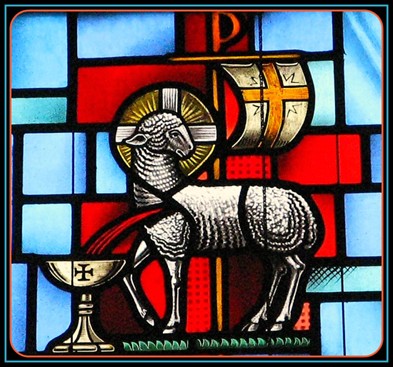
We are working our way through the Gospel of John in this fourth year of the Narrative Lectionary. One of the interesting threads in John’s Gospel is his focus on Jesus as the Lamb of God. That name for Jesus is used twice in chapter 1. First, John (the Baptist) sees Jesus coming toward him and declares, “Here is the Lamb of God who takes away the sin of the world!” (1:29) And just a little later, John repeats a similar phrase as he stands with two of Jesus’ disciples: “Look, here is the Lamb of God!” (1:36).
For those who were familiar with the story of the Jewish people, when they heard this, they might have recalled the very first Passover when the people were still living in Egypt. One of the directions for this remembrance was this: “Go select lambs for your families, and slaughter the Passover lamb. Take a bunch of hyssop, dip it in the blood that is in the basin, and touch the lintel and the two doorposts with the blood in the basin” (Exodus 12:21-22). The blood was a protective sign to the avenging angel (“the destroyer”) not to enter the houses of the Israelites as it went about killing the first-born of the Egyptians.
Centuries later, in Jesus’ day, Passover continued to be celebrated in Israel. During this eight-day festival, lambs were slaughtered as sacrifices to God. In John’s Gospel, Jesus makes three different pilgrimages to Jerusalem to observe the Passover. His first pilgrimage results in his wild cleansing of the temple grounds (the Court of the Gentiles, to be precise). Jesus makes the important claim that the temple (that is, the temple of his body) would be destroyed, and he would be raised again in three days. This connection of Jesus’ death to Passover is certainly not an afterthought in John’s Gospel. It is for John one of the keys to who Jesus is: he is the Lamb of God who takes away the sin of the world.
The third time Jesus comes to Jerusalem to celebrate the Passover, John says that “Jesus knew his hour had come to depart from this word and go to the Father” (13:1). And, of course, this is what happens. But here, John’s Gospel has a unique twist. In the Gospels of Matthew, Mark, and Luke, Jesus dies on the first day of the Passover. In John’s Gospel, Jesus dies a day earlier, on the Day of Preparation, at the same time the sacrificial lambs for the Passover would have been slaughtered! John’s message seems unmistakable: Jesus is the sacrificial Lamb of God, who took and keeps on taking away the sin of the world.
Thank you for the Lamb, the precious Lamb of God. Because of your grace I can finish the race; the precious Lamb of God. Amen (ELW 341)