
Today’s author is Prince of Peace member, Ruth Hagander
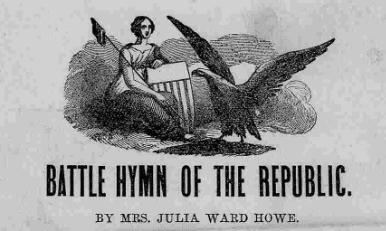
The topic today is about the familiar song “Battle Hymn of the Republic” written by Julia Ward Howe during the Civil War. According to history, she was well versed in Scripture and according to Craig Koester in his book about Revelation, it was verses 19 and 20 in chapter 14 that inspired her to write this well-known song. Koester says, “She wove images from Revelation together with images of the conflict. Like the book of Revelation, her hymn served as an uncompromising call to commitment.”
In the early months of the war, Howe, an avid abolitionist, visited Washington D.C. and heard Union troops belting out a well-known marching song, “John Brown’s Body”. A friend encouraged her to write. new words to that old tune. A few months later, she completed the new version and sold it to “Atlantic. Monthly” for $5.00. That new version, sung to the old tune, spread quickly through the Union Army. It is relevant to know that music was an integral element in the war. Soldiers were trained to recognize a variety of tunes played on bugles, fifes, and drums that helped organize the movement of troops and conveyed combat orders – forward, halt, roll call, drills, meal time, and charge into battle. Other songs were played to boost morale.
Some musicologists place “Battle Hymn” in the category of patriotic songs. Others support it as a hymn. It was sung in exhortation before battles and then joyously upon news of military victories. Some say it is anti-Christian because it was written for the purpose of giving Union troops license to kill their southern neighbors. Along that line, some refer to Revelation 19 which challenges to give allegiance to Him as opposed to giving allegiance to nations with their “military conquerors and political entities”. Those critics say “Battle Hymn” is not for church worship because its military image does not fit with the image of God of peace and the command to love our neighbor. However, one could argue that Howe’s passion for freeing the slaves was because of love and respect for all of God’s creation. When the song is sung in a church service, the intent is to honor all who have died in the struggle for freedom.
Our ELW hymnal includes “Battle Hymn” in a small section at the back of the hymnal titled National Songs. The older LBW hymnal (green cover) included this anthem in a more extensive section titled Christian Hope. Notice the one-word change in verse three, line three of the original version (let us “die” to make men free) compared to that line in our current hymnal (let us “live” to make men free). Recognizing diverse opinions and reflecting on freedom, it is the love and light of Jesus that unites us.
Gracious God: We give thanks for songs, singers, messages that challenge, and messages of peace and love. Amen