
Today’s author is Prince of Peace member, Bob Reichman
Ezekiel 37: 1-14 (Valley of Dry Bones)
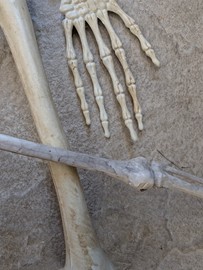
As a child, and well into adulthood, I was very thin. So thin, in fact, that one of my dad’s favorite nicknames for me was “Bones,” as in, “You’re nothing but skin and…”
I was occasionally told by (helpful?) relatives, friends and acquaintances, “You need to put some meat on those bones,” and “It’s good to be thin, but you’re too thin.” My response to the latter, “For what?” Yes, I would have made a poor offensive lineman, sumo wrestler or playing the part of The Incredible Hulk. And sure, a strong wind could be a challenge for me. But I could get through narrow openings that no one else could – prison bars probably could not hold me – and beyond that, it felt like who I was. Except for one brief, unsuccessful, attempt to bulk up with a milkshake a day (which had other rewards), I accepted that I was thin, even though it was too thin for some people’s sensibilities.
The Minnesota Twins had a relief pitcher in the 1960s and ’70s named Tom Hall, whose nickname was “The Blade,” because if you looked at him from the side it was like looking at a razor blade. Is it surprising that he was one of my favorite players?
When I moved to Milwaukee for a job in my mid-30s, I had no idea that my lifelong paper-thinness was nearing an end. In my first six months there, I gained 17 pounds. I wasn’t eating any differently, but my metabolism was apparently slowing down from its lightning speed. Or maybe it was just the beer, cheese, sausage and frozen custard in the air. Since then, I’ve gained more weight, and although I still look thin, I have climbed into the average weight category.
Sometimes, things that seem like they will always be the case change unexpectedly. That was certainly the case with the Valley of Dry Bones.
The priest and prophet Ezekiel had chastised Israel repeatedly for its faithlessness, which seemed confirmed by the destruction of the temple in Jerusalem and exile to Babylon. But he saw hope for the restoration of Israel because of God’s faithfulness. In a vision, he saw a valley of bones long since bearing any resemblance to living tissue. Even zombie movies usually have more to work with. Following God’s instruction, he prophesied and the bones came together and sprouted muscle and flesh. The bodies were filled with the breath of life, and soon the valley was home to “a vast multitude.” God told Ezekiel that the bones represented the destruction of Israel and that their return to life symbolized its eventual restoration.
For Israel, the idea of ever being restored seemed remote. But Ezekiel knew that our world isn’t static, and that’s especially true when God is involved. We will probably never see dry bones spring to life, but many things we believe to be permanent are not. For those things that are, we have to find a way to live with them. But God will help us with that, too.
Prayer We can be our own worst enemies, God, by not recognizing who we are and not listening to your guidance. Help us to remember to hope when darkness comes and to know that you are always working with us to change things for the better.