Today’s author is Prince of Peace member, Carol Swanson.
We’ve spent the month of July getting to know the Book of Revelation a bit and still have a couple more weeks to go with it. Such a strange book! Many a time that has been said this past month! Do you still feel a bit confused and not sure what to think about it? Maybe a recap at this point would be helpful.
Like all the “books” of the New Testament following the four Gospels and Acts, the Book of Revelation is a letter to churches. It is written by a man named John (not thought to be John of the gospels), exiled on the island of Patmos, to 7 churches in Asia Minor (present-day Turkey). It is also known as the Apocalypse, which simply means “revelation” in Greek. There are other apocalyptic passages in the Old Testament prophets from the Babylonian exile and later occupations, and in the gospels. They “reveal” the word of God through metaphor and visions—thought-provoking, incredible, some bizarre. John alludes to many of these same images and passages that would be well-known to his audience, but he combines, alters, and enhances them in startling fashion.
John has a “revelation of Jesus Christ, which God gave him to show his servants” (1:1). The letter (the “book”) is to be read aloud to the congregations. Verse 3 says, Blessed is the one who reads aloud the word of the prophecy, and blessed are those who hear and who keep what is written in it; for the time is near.
In the first chapter John describes who he sees while “in the spirit”: one like the Son of Man…his hair…as white wool…his eyes were like a flame of fire…he held seven stars, and from his mouth came a sharp, two-edged sword, and his face was like the sun shining with full force. “Do not be afraid; I am the first and the last,… alive forever and ever; and I have the keys of Death and of Hades….” (Read 1:12-20) Of course, this is John’s first vision of Jesus Christ, the faithful witness, the firstborn of the dead, and the ruler of the kings of the earth. (1:5a)
It is meant to be a blessing, God’s word of hope. The churches are encouraged by their angels, but they are also warned. Those facing persecution will suffer. Those wanting to fit in with society and therefore comprise their faith are called to repent or face consequences. Also, those with lukewarm faith of little value or affect must repent and revive their faith or face consequences (chapters 2 and 3).
In chapter 4, John sees an open door to heaven and is invited to come up; we readers go with him. It is the throne room of God. God is manifested “like jasper and carnelian” on the throne with “flashes of lightning and rumblings of and peals of thunder” (like on Mt. Sinai). Twenty-four elders (for 12 tribes of Israel and 12 disciples, perhaps), four living creatures (like a lion, ox, human, and eagle), and angels periodically sing heavenly praises. Surprisingly, we modern readers will recognize so many of these as part of our hymns and liturgy. Who knew! Revelation has been the inspiration for so much music. Seven times throughout the book we are brought back to healing rest in this music of praise between the unsettling and bizarre cycles of visions of warning that John shows us. And each time there are more and more singers—myriads of angels, countless tribes, and nations and languages, and all the creatures of sky, earth, and sea. It makes me think of our need to gather weekly to worship together and be renewed to go out into the world.
In chapter 5, John sees a sealed scroll in the hand of the one (like jasper and carnelian) on the throne. An angel calls out, “Who is worthy to open the scroll and break its seals?” There is no one worthy to be found anywhere in heaven or on earth, and John weeps. But then he hears one of the elders says, “See the Lion of the tribe of Judah, the Root of David, has conquered, so that he can open the scroll and its seven seals.” (5:5) The Lion, symbolizes strength, kingship, a predator. This is what John expects. But he turns and sees “a Lamb standing as if it had been slaughtered… (5:6), symbolizing weakness, meekness, a victim. “Worthy is Christ, the Lamb that was slain, whose blood set us free to be people of God,” we sing in church liturgy. (Compare to 5:9, 12) This has already been accomplished!
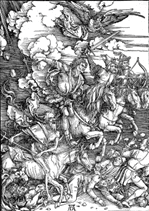
In chapter 6, we see the first cycle of warning, the opening of the 7 seals. It is the most well-known, and (I think) the most meaningful. The first four seals are the 4 horsemen who represent Conquest (of borders), Violence (more local), Economic Insecurity (often looms the largest in our minds) and Death and Hades (by sword, famine pestilence, wild animals). The 15th century artist Albrecht Dürer, illustrates this so well. The 5th seal reveals Martyrs who pray to God, “How long will it be before you judge and avenge our blood?” are given a place of safety and rest. The 6th includes cosmic catastrophes. The 7th seal (the worst yet?) is delayed.
Where is God in this? The four horsemen are given authority by…God? By Christ who broke the seal? Or by us? It doesn’t say. John is addressing churches with issues living in the Roman empire. Those under persecution find hope and encouragement with the 5th seal. The others, do the churches feel unsettled by them all? And what about us? As individuals, as societies and nations, we sin. Our selfishness and greed, our desire for control and power. Our poor choices and mistakes. We sin “by what we have done and what we have left undone,” as we traditionally confess. We are all connected and affect one another.
The seventh seal is delayed, so that the faithful servants of God could be marked with a seal on their foreheads to protect them. And it is time to sing praises and be renewed as well.
But then the last seal opens to start the next cycle of the 7 trumpets in chapter 8 and 9. These echo the Exodus story when God heard the people groan and cry out and sent Moses and the ten plagues to make Pharaoh change his mind and let God’s people go. As the New Oxford Annotated NRSV describes John’s version, “The first six trumpets introduce new convulsions of nature, in judgment on the wicked.” In nightmarish fashion, the angels blow their trumpets and throw down hail and fire, mixed with blood…and a third of trees and sea life perish. The sun and moon are hit and there is one third darkness. And out of the bottomless pit come giant locusts to chew people instead of grass— to torture, not kill. But with the 6th trumpet, come invaders: 200 million cavalry troops on monster-like horses with fire-smoke-sulfur breath and serpent tails that kill a third of humankind.
These visions are meant to be threatening, to warn, to bring about change. But like Pharaoh who didn’t change, we read, “The rest of humankind, who were not killed by these plagues, did not repent…or give up worshiping demons and idols… their murders, or their sorceries or their fornication or their thefts” (9:20-21).
The seventh trumpet is delayed, just as the seventh seal had been. What will happen? What is God telling us through these visions of John? More on this tomorrow with reflection.
We pray together. Gracious God—Creator, Savior, and Comforter: Give us patience and understanding. Renew our hearts and minds through your word. Amen.