
Today’s author is Prince of Peace member, Carol Swanson.
I saw another mighty angel coming down from heaven, wrapped in a cloud, with a rainbow over his head; his face was like the sun, and his legs like pillars of fire. He held a little scroll open in his hand. Setting his right foot on the sea and his left foot on the land, he gave a great shout, like a lion roaring. And when he shouted, the seven thunders sounded. (Rev 10:1-3)
What an impressive image, this messenger of God! I think of the theophanies of God in Exodus: the pillar of cloud by day and fire by night assuring the Israelites of God’s presence guiding them through the wilderness; the rumbling thunder on Mt Sinai; and how Moses’ face was shining when he came down the mountain from God’s presence, his face shining with God’s glory. This angel, more than Moses, reflects God’s glory as he mightily straddles land and sea (God’s dominion), wrapped in a cloud and rainbow, face shining, voice like a roaring lion, thundering.
The rainbow, God’s promise to Noah to never destroy all living creatures again, a universal covenant for the whole earth, repeated many times as emphasis in 10 verses (Gen 9:8-17). The New Oxford Annotated NRSV notes: “Ancients imagined the rainbow as the weapon (bow) of the Divine Warrior from which the lightnings of arrows were shot (Ps 7.12-13; Hab 3.9-11). The placement of this weapon in the heavens is a sign, or visible token, that God’s wrath has abated.”
What strikes me is that this vision of John’s follows immediately after the vision of the 6th trumpet when a third of humankind are killed, and we read the final words of that chapter: The rest of humankind, who were not killed by these plagues, did not repent…or give up worshiping demons and idols… their murders, or their sorceries or their fornication or their thefts (9:20-21).
And now this mighty angel of God gives John a small scroll, and tells him, “There will be no more delay, but in the days when the seventh angel is to blow his trumpet, the mystery of God will be fulfilled, as he announced to his servants the prophets” (10:6b-7). He tells John to eat the scroll (the word of God) so that he can “prophesy again about many peoples and nations and languages and kings.” (10:11)
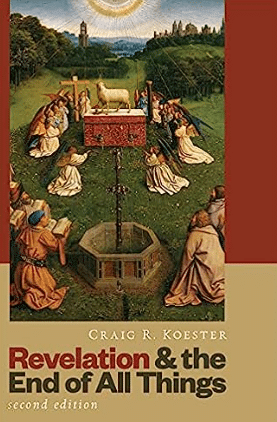
In chapter 11, John is told to measure the temple of God and the altar. The point is, says Craig Koester in his book and video series, the temple is not just a building but is the people of God. That is what we say of the Church as well; we are to share, proclaim, the word of God. Two witnesses are chosen to prophesy in sackcloth for 1260 days. They are the “lampstands” of the temple. When they finish, they are killed by the beast from the bottomless pit and left in the street while the people celebrate. But after 3 ½ days, the breath of God enters them again (like Ezekiel’s dry bones vision), and they stand. The people are terrified. As the martyrs are taken up to heaven, an earthquake destroys a tenth of the city and 7,000 are killed. Those who are left “were terrified and gave glory to the God of heaven.” (11:13)
Then the seventh angel blew his trumpet, and there were loud voices in heaven, saying,
“The kingdom of the world has
become the kingdom of our Lord
and of his Messiah,
and he will reign forever and ever.”
[Can you hear Handel’s Messiah revealing the mystery of God?]
The elders fall on their faces and sing praise to God who has begun his reign.
“The nations raged,
but your wrath has come,
and the time for judging the dead,
for rewarding your servants, the prophets
and saints and all who fear your name,
both small and great,
and for destroying those who destroy the earth.” (11:15-18)
Koester notes, “In this passage we see an image of the suffering and vindication of the people of God” (p 112). But is this also advocating for an avenging God?
I found what Koester wrote next to be enlightening.
“In the end, judgment does fall upon the nations, but its force is blunted. John says that an earthquake occurred ‘and a tenth of the city fell; seven thousand people were killed in the earthquake’ (11:13). The progression toward total judgment, which seemed unstoppable in the series of visions that were recounted in Revelation 8–9, is now reversed. Each of those visions spoke of disaster falling upon a third of the earth, culminating with the specter of death for a third of humanity (9:18). At the end of Revelation 11, however, destruction falls on only one-tenth of the city, which means that nine-tenths of the people are spared. To sense the magnitude of the change, consider how this reverses a broader biblical pattern. Isaiah warned that God’s judgment would fall so widely that only a tenth would survive it, and that even that tenth would be burned again (Isa 6:13). Similarly, Amos warned that when God’s judgment came, nine-tenths would meet destruction (Amos 5:3). In Revelation, however, the opposite is true, for nine-tenths are saved and only one-tenth are destroyed.
“After the earth experienced the horrors of the first six trumpets, people stubbornly persisted in idolatry and refused to repent (Rev 9:20-21), but here nine-tenths of the people give glory to God, which is what the heavenly chorus did with their songs of praise (4:11; 5:13; 7:12). The witness, death, and vindication of the community of faith accomplish what the prospect of judgment alone does not do. It brings people of many tribes, languages, and nations to fear God and to give him glory. Note that in the days of Elijah—whose legacy is carried on by the two witnesses, as noted above—all but seven thousand people embraced false worship (1 Kings 19:18). In Revelation, however the situation is reversed, for all but seven thousand now give glory to God (Rev 11:13). The conversion of the nations, rather than their destruction, is God’s will for the world (14:7)” (Koester, 112).
Koester says this is the end of Act I of the Book of Revelation. Act II (the second half of the book) begins with chapter 12, the story of the pregnant woman pursued by the dragon, the text so beautifully shared by Pastor Melanie on July 23. Debbie preached this past Sunday on “Babylon the Great” and the beast she rides on (ch 17), recognized as Rome, the New Babylon. Both sermons are definitely worth listening to again and available on the website. Koester and Keller both recognize that the descriptions of the whore and the beasts use lampooning and satire to compare the kingdom of God and the Lamb with Rome’s empire. The emperors of Rome were described as gods and claimed to bring progress, success, and true peace (Pax Romana) to the world (through conquest and military control).
God of Grace and Peace, you call and claim us as your own. May your grace help us fight the evil that is in and around us with the Good News of Jesus. Amen.