Today’s author is Prince of Peace member Carol Swanson.
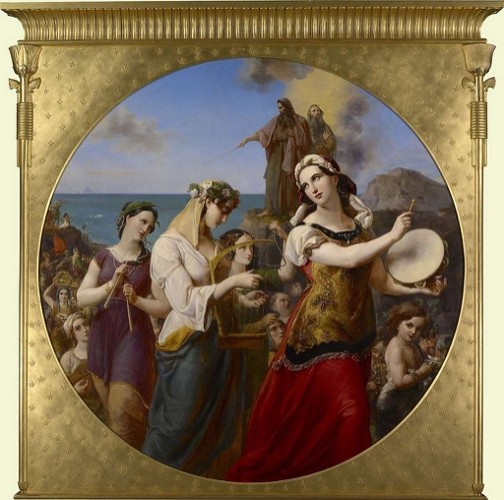
Royal Collection of the United Kingdom
For I brought you up from the land of Egypt.
and redeemed you from the house of slavery;
and I sent before you Moses, Aaron, and Miriam.”
––Micah 6:4
By the first century, 1 out of 4 Jewish women were named after Miriam–– or Mariam (Greek), or Mary (our English translation) –– so honored was the sister of Moses. In Exodus 2, she is the (unnamed) sister who watches the baby Moses in the basket in the river, approaches Pharaoh’s daughter in offering to find a nurse (their own mother) which brings Moses back home safely during his infancy. Next, we see her after the crossing of the Red Sea in Exodus 15:20, now referred to as “the prophet Miriam, Aaron’s sister,” leading the women in singing and dancing with tambourines. “Sing to the LORD, for he has triumphed gloriously; Horse and rider he has thrown into the sea.” The footnote in the New Oxford Annotated Bible says vs 21 is “The Song of Miriam, one of the oldest poetic couplets in the Old Testament.” The Lutheran Study Bible notes “The mention of Miriam as a prophet is significant because men generally held the leadership positions and power in the culture of the time.” So, most of us don’t know much more about Miriam, as these two poems from Thomas John Carlisle express:
Accreditation
Mariam’s brief biography
(in Exodus and Numbers)
gives her minimal mention
considering––
or not considering––
her contributions
and her character.
We encounter hints
and intimations
of her finesse
and her sagacity
and versatility,
her skill in music
and her power in poetry
as well as her esteemed position
in the hearts of all her people.
She was a chief
executive––
one of three––
as we discover
when we read between the lines.
Why should we need
to toil so arduously
in order to surmise
and recognize
her stature?
MIRIAM (In Fifty Words or Less)
Supportive sister
who guided the pitch-patched ark
to the King’s daughter
Emancipation’s
mouthpiece singing victory
in words she fashioned
Government sharer
skillful administrator
in triumvirate
Moses’ challenger––
in company with Aaron––
no march without her
Blend of tenderness
and toughness this Miriam
poet and prophet.
–Exodus 2, 15; Numbers 12; 20:1; 26:59; Micah 6:4
(From Eve and After: Old Testament Women in Portrait, 35, 36. Available soon in our library.)
Still, why were 1 in 4 Jewish women named a variation of Miriam in the time of Jesus? Under the control of Rome, the Jews were looking for a new Moses or messiah to free them. Midrash and popular retellings of Exodus concerning the birth of Moses tell of Hebrew couples in Egypt divorcing or separating rather than having their male babies killed. “But one father, Amram, refuses to join that general decision and advises remarriage for all. Then, in a revelation, God rewards him for his trust by promising that Moses would be his son.” In some versions, God also comes to Amram in a dream, and in others God comes to Miriam.
God came upon Miriam one night, and she saw a dream and told it to her parents in the morning, saying: I have seen this night, and behold a man in a linen garment stood and said to me, “Go and say to your parents, ‘Behold he who will be born from you will be cast forth into the water; likewise through him the water will be dried up. And I will work signs through him and save my people, and he will exercise leadership always.’” And when Miriam told of her dream, her parents did not believe her. (Borg & Crossan, The First Christmas, 106-107. Available in our library.) Scholars think such stories inspired the Gospel of Matthew’s version of Christmas: Joseph thinking of divorce, remarriage, dreams– along with Herod’s fears and actions recalling Pharoah’s. Matthew 1 and 2 provide an overture to seeing the story of Jesus paralleling Moses. (We will hear Matthew’s Christmas story in worship December 27 and January 3.)
When I first read Carlisle’s poems, I wasn’t sure what this one stanza meant for Miriam–– “Moses’ challenger–– in company with Aaron–– no march without her.” So I looked up the texts he notes at the end of the poems and did a little more research. The stanza reflects Numbers 12, which rabbis have argued over for millennia. What happened???—too complicated to present here. But the outcome was that Miriam received a skin disease—as punishment? The Jewish Women Archive link below this devotion says Miriam “is mentioned as the one who prophesied the birth of Moses and his role as the deliverer who would redeem Israel from the Egyptians, a task in which she would assist him. Her reward came when she contracted leprosy and the Ark, the Divine Presence, and all Israel waiting for seven days until she was healed.” “Because she is so beloved by her people, they refuse to travel without her (12:15),” the Lutheran Study Bible concludes.
Jewish women celebrate Miriam’s leadership, her music and poetry, and associate her with the well providing water for all the thirsty Israelites just after her death. Many in the New Testament are named for her, including Mary the mother of Jesus, Mary Magdalene, Mary of Bethany (sister of Martha), Mary the mother of Cleopas, the “other Mary,” Mary mother of John Mark, and Mary a faithful worker in Rome greeted by Paul. Many more variations of her name are found around the world today.
God of holy inspiration, we thank you for Miriam, one blessed to be a blessing in her own time and throughout the ages. May her name and story continue to inspire us to follow your way on our life journey. Amen.
For more on Miriam, visit: https://jwa.org/encyclopedia/article/miriam-midrash-and-aggadah