Today’s author is Prince of Peace member, Carol Swanson.
Please note that there will be devotions published Monday – Friday this week.
We had looked forward to hearing our guest preacher and forum speaker, Dr. Kelly Sherman-Conroy, on Sunday, and then she didn’t arrive. Was there an emergency? Miscommunication? We learned what happened shortly after church. We got word from her booking assistant that she “had a tumble down her stairs” as she was getting ready to come to PoP, and “she ended up driving herself to emergency” without her phone. She has “a partial dislocation of her shoulder and a slight concussion.” So please pray for her continued recovery from her injuries.
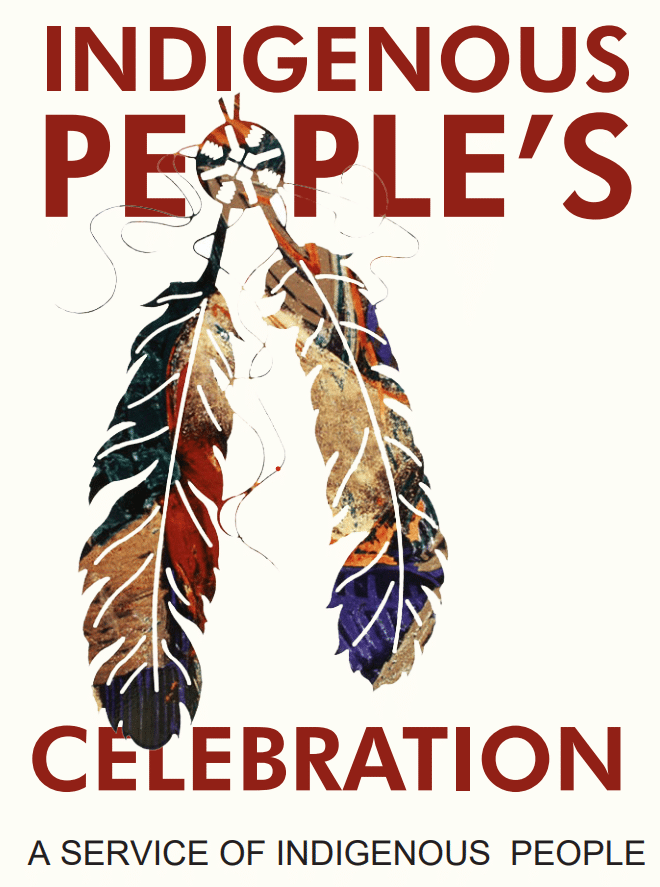
In his Friday devotion, “Embracing Reconciliation,” Pastor Peter quoted Dr. Kelly’s website: “Her work primarily focuses on systemic theology, with a unique approach to Lakota Spirituality and how it can inform Christianity and instill healing.” With that in mind, I’d like to share part of the “INDIGENOUS PEOPLE’S CELEBRATION, A Service of Indigenous People,” written and compiled by Kelly when she was a Doctoral student at Luther Seminary and active member of the American Indian/Alaska Native Lutheran Association Inc board of directors.
In the Repentance portion of the liturgy, the Doctrine of Discovery is mentioned. I did a little reading up on it on Wikipedia and other sites. It has a long history going back (even before) the 1400s when papal bulls sanctioned explorers from Portugal and Spain to claim lands “discovered” and to “subjugate” the people (including enslavement), the taking of their lands, in order to bring them into Catholic faith. England and France soon started claiming lands as well and it soon became accepted international law. Thomas Jefferson, as our first Secretary of state, also claimed this right for the new United States. Down through history it has been the basis of treaties and court cases. The most recent official citing of it by the US Supreme Court was in 2005, by Justice Ruth Bader Ginsberg, writing for the majority, in City of Sherrill v Oneida Indian Nation of New York.
In 2007 the United Nations adopted the Declaration on the Rights of Indigenous Peoples, which acknowledges the “rights of Indigenous peoples to their land”. As Wikipedia states, “The only nations to vote against the declaration were the United States, Canada, Australia, and New Zealand. All four would later reverse their positions.” Since then, several churches have passed resolutions officially repudiating the discovery doctrine. The Episcopalians (2009), Unitarians (2012), United Church of Christ (2013), Presbyterians and the ELCA in 2016, and recently the Vatican in 2023. It’s a beginning.
From the INDIGENOUS PEOPLE’S CELEBRATION:
REPENTANCE
PRESIDER: Creator and Redeemer,
As we approach you in prayer,
Make us walk in beauty and balance.
Make us open our hearts and minds.
Make us speak the truth.
We pray first for your Community, the Church,
The Body of Christ.
We pray for all our relatives in the circle of life
Throughout all Creation;
For those chosen to be our leaders;
In peace, we pray to you, Lord God:
VOICE 1 (Native): An excerpt from the Repudiation of the Doctrine of Discovery from the ELCA Churchwide Assembly in 2016. “To repudiate explicitly and clearly the European-derived doctrine of discovery as an example of the “improper mixing of the power of the church and the power of the sword”, and to acknowledge and repent from this church’s complicity in the evils of colonialism in the Americas, which continue to harm tribal governments and individual tribal members.
VOICE 2 (Non-Native): Christians have often focused on what separated them from Native people rather than looking for what united them. Their failures to find a uniting front resulted in the deaths of hundreds of thousands of Native people and the forced assimilation of people. We deeply regret the decisions that resulted in these atrocities. Following the 2016 Resolution we affirm that our congregation and the Evangelical Lutheran Church in America will eliminate the doctrine of discovery from its contemporary rhetoric and programs, electing to practice accompaniment with native peoples instead of a missionary endeavor to them, allowing these partnerships to mutually enrich indigenous communities and the ministries of the ELCA.
PRESIDER: Let us pray (moment of silence)
ALL: O God of mercy, we lament that even good actions of reform and renewal had often unintended negative consequences.
PRESIDER: We bring before you the burdens of the guilt of the past when our forbearers did not follow your will that all be one in the truth of the gospel.
ALL: Teach us and show us the way.
PRESIDER: We confess our own ways of thinking and acting that perpetuate the divisions of the past. As communities and as individuals, we build many walls around us: mental, spiritual, physical and political walls that result in discrimination and violence.
Forgive us, Lord.
ALL: Teach us and show us the way.
PRESIDER: Christ is the way, the truth and the life. He is our peace, who breaks down the walls that divide, who gives us, through the Holy Spirit, ever-new beginnings.
ALL: Teach us and show us the way.
PRESIDER: In Christ, we receive forgiveness and we are strengthened for a faithful and common witness in our time.
ALL: Teach us and show us the way.
PRESIDER: We pause now to add our own prayers, either silently or aloud. Creator, you made the world and declared it to be good: The beauty of the trees, the softness of the air, The fragrance of the grass speaks to us; The summit of the mountains, the thunder of the sky, The rhythm of the lakes speaks to us; The faintness of the stars, the freshness of the morning, The dewdrops on the flower speak to us. But above all, our heart soars, for you speak to us. In your Son, Jesus Christ, In whose name we offer these prayers.
ALL: AMEN
See the entire service and introduction to the ELCA resolution by CLICKING HERE.