
Today’s author is Prince of Peace member, Scott Tunseth.
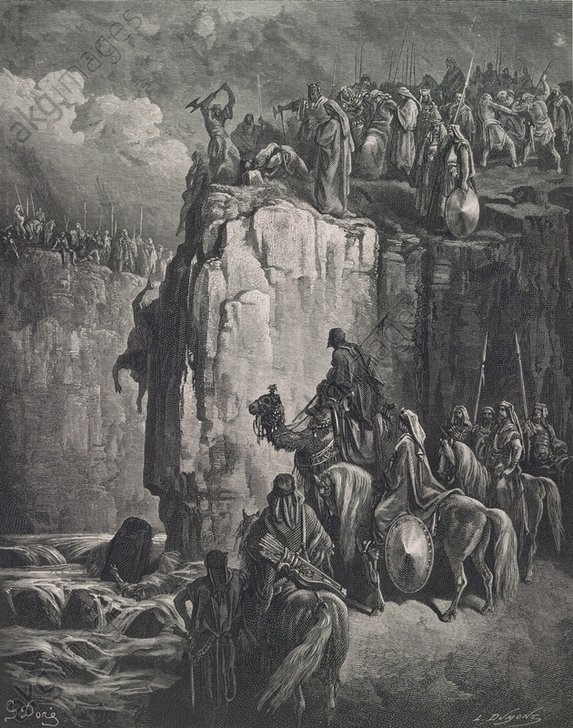
Gustave Dore (1832–1883)
Wood engraving after the drawing by Gustave Dore.
Akg-images
This week’s lesson from 1 Kings is a stomach-turner. I agreed to write the devotion for this challenging text several weeks ago, even making the offhand remark that “I must be feeling violent.” That was at least three weeks before Hamas soldiers entered Israel and murdered over a thousand Israelis and other nationals and carted over 200 hostages back to Gaza. And since, we have seen Israel retaliate by raining fire on Gaza. The body count on both sides continues to rise.
We turn to our faith and our sacred Scriptures in times like this to find comfort and maybe even a word that helps us make sense of it all. But today’s lesson provides neither. It does plunge us into the reality of the bloody struggles that sometimes mark religious fervor and conflict. And it’s a reminder that things don’t seem to change all that much.
The main character in the story is the prophet Elijah, a miracle-worker who lived in the Northern Kingdom of Israel (the ten tribes that seceded from the two southern tribes in Judah after Solomon died and his son Rehoboam decided to listen to his young advisors, telling the northern tribes that he would treat them even more harshly than his father (“I will discipline you with scorpions.”) Violence all around.
The northern tribes, according to 1 Kings, spawned some unfaithful leaders who built shrines to the Canaanite gods Baal and Asherah, to whom they offered sacrifices, even while worshiping the Lord. It was religious syncretism of the highest order and a clear violation of the First Commandment: “You shall have no other gods.” Israel’s King Ahab and his wife Jezebel were two of the most notorious offenders: “Ahab son of Omri did evil in the sight of the Lord more than all who were before him” (1 Kings 16:30).
Today’s story brings Elijah face to face with Ahab, who calls Elijah the “troubler of Israel.” Ahab had no idea how much of a troubler Elijah would be! Elijah arranges a contest between himself, the lone true prophet in Israel, and the priests of Baal and Asherah, who numbered over 800 altogether. The contest would determine whose God was most powerful. Elijah builds an altar and places a sacrifice on it, and the priests of Baal and Asherah do the same.
First, the priests of Baal cry out to God to rain fire on the offering and burn it up, but nothing happens, which leads to the priests cutting their bodies in despair. Violence all around. Then it is Elijah’s turn to cry out to God after three times dousing his sacrifice and the trench around it with water. Elijah cries, “Answer me, O Lord, so that this people may know that you, O Lord, are God.” In answer to Elijah’s prayer, God rains fire on Elijah’s sacrifice and burns up everything, including the water. The people are amazed and cry out, “The Lord indeed is God!” (18:39)
The point of the story, of course, is that there is only one true God, and those other gods that some follow, well, they just aren’t as powerful. The story could end here and be just another one of Elijah’s God-driven miracles. But the story is not done yet. It’s not enough that God’s power was proven in such a dramatic way; no, Elijah has yet one more task. He says to the people, “‘Seize the prophets of Baal; do not let them escape.’ Then they seized them and Elijah brought them down to the Wadi Kishon and killed them there” (18:40).
Do you see why our lesson ends at verse 39?
Violence all around. What we are witnessing today in the Middle East feels like an extension the violence we see in the story of Elijah and the priests of Baal. The modern conflict is political, yes, but at its core it is deeply religious. Whose land? Whose God? Whose theology? Whose ethics? Yes, one strategy is simply to kill others who don’t believe what we believe, and that has certainly been tried through the ages. But raining fire in this way has never worked. It is not the final solution.
For me, I need to turn to a different part of Scripture and imagine what it calls me to be and do:
“If I have prophetic powers and understand all mysteries and knowledge and if I have faith so as to remove mountains but do not have love, I am nothing” (1 Corinthians 13:2). It’s hard to imagine such love raining fire anywhere on anyone. And yet, it happens. Is there anything more difficult than loving . . . really loving?
O God, the violence all around is simply overwhelming. We believe that you desire mercy and peace wherever fire and fury exist. Teach us to live by love, the truest miracle, through the power of Christ. Amen