Today’s author is Prince of Peace member, Carol Swanson.
Please note that there will be devotions published Monday – Friday this week.
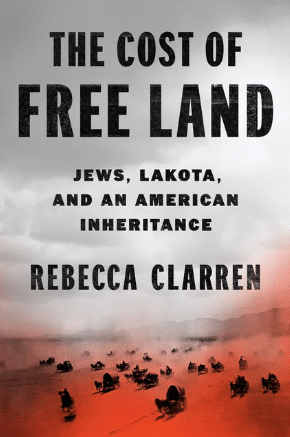
On Sunday, when we realized Dr. Kelly might not be coming to the adult forum, Toni Sveom stepped in to share her excitement about a book she is in the middle of reading, The Cost of Free Land by Rebecca Clarren, an award-winning journalist, writing about her Jewish family’s settling in western South Dakota after fleeing Russian pogroms. A new life for her family, but now she sees, at such great cost to the Lakota. Toni guided our discussion, asking us to share our knowledge on buffalo, treaties, boarding schools, and more. Pooling what we knew led to a very good discussion. Shared bits and pieces of history. For me, a reminder of how little I really know and understand.
I did a little googling, as usual, and found a very recent article by Rebecca Clarren to promote her book. The article is called “The Stolen Beam,” and I’d like to share a couple of portions. Realizing how her family history and the Lakota’s history are so intertwined, affecting all for generations, she turned to her faith leaders for insight. Like King Josiah in our Sunday text, Clarren found wisdom in Deuteronomy. (See Deut.21:1-10.)
The Torah teaches that, even if we as individuals haven’t committed harms directly, we are responsible because sin has a communal effect and must be dealt with collectively. In Deuteronomy, there’s a teaching that, if a murdered person is found in the road and no one knows who the murderer is, the crime must be absolved by those who live nearby (in ancient days, this required a bloody ritual involving a river and a heifer). To determine which community should incur the economic damage of sacrificing animals for this ritual, the leaders of the closest towns would measure their distance from the victim, and those living closest to the corpse would assume responsibility. But if nothing was done, the land would become polluted, endangering everyone.
“Sin is not a private affair, sin is social, and its effects are felt by the entire community,” Toba Spitzer, a Reconstructionist rabbi, once said in a Yom Kippur sermon about this Torah portion. She urges us all to ask ourselves, “What measuring stick links me to the foundational sins of this nation? How am I connected?”
Later, Clarren shares how rabbis reflect on a story from the rabbinical tradition:
Ignoring [our]history diminishes the legitimacy and the power of our nation, writes Sharon Brous, a rabbi and the founder of IKAR, a Jewish community in Los Angeles. There’s a debate described in the Talmud between two rabbis over what should be done if it’s discovered that a house, or even a palace, was built using a stolen beam as part of its foundation. One rabbi says the entire building must be demolished so that the beam can be returned to its original owners. The other rabbi, far more pragmatic, says the building can remain standing if the full value of the beam is repaid. Both rabbis make it clear that, as soon as it is known that the beam was stolen, those living in the house must do something—they must make amends.
“Our country was built on a stolen beam,” wrote Brous in a 2017 Rosh Hashanah sermon. She considers the teachings of Rabbi Sholom Noach Berezovsky, who explained that building without a solid foundation inevitably leads to collapse. A Holocaust survivor, he understood the societal danger of theft and denialism.
(The article can be found at https://momentmag.com/jews-lakota/)
What are we called to do? As a community? And as individual members of the community?
We listen. We learn. We acknowledge the truth, confess the harm done, and work on bringing about justice and healing and reconciliation. Together, as community, we can be God’s hands.
We listen. We learn. We can grow to appreciate God the Creator’s love of diversity and desire for inclusivity. Together, we are all the body of Christ with gifts to share that enrich one another as we journey on the Good Road.
In the last month or so, PBS has had some very fine programming on Native history and culture, including Ken Burns’ The American Buffalo (parts 1 and 2),Little Bird (on forced adoption trauma, 6 parts), Native America, season 2 (4 parts) –all currently available on PBS Passport. A wonderful resource for learning.
I wrote this devotion yesterday, but I must share one more thing before I submit it: I believe God is serendipitous. When I opened to Deuteronomy to search for the passage Rebecca Clarren referred to, my eyes were first drawn to the end of chapter 16 (vs 20): “Justice, and only justice, you shall pursue, so that you may live and occupy the land that the LORD your God is giving you.” Are we listening?
Let us pray together: God of justice and of healing grace and love, give us ears and hearts to be open to one another, so that we can be one with you and hear your call and follow you. And bring comfort and healing to your beloved child, Kelly Sherman-Conroy. Amen.