
Today’s author is Prince of Peace member, Carol Swanson.
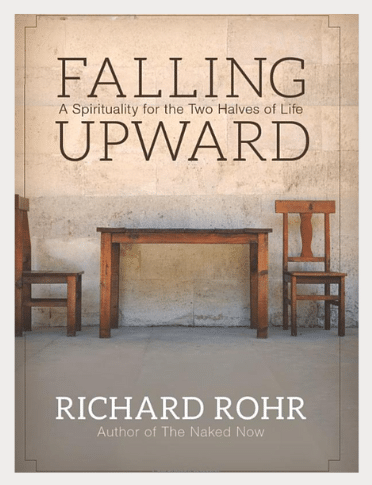
Currently, some of us have been participating in a book study at Prince of Peace on Sunday afternoons, discussing Richard Rohr’s book, FALLING UPWARD, A Spirituality for the Two Halves of Life. Having been asked to read the first four chapters for the first meeting, some of us (including me) still confessed to not being exactly sure of where Rohr was leading us but still curious and wanting to know more. To quote the jacket blurb, “In Falling Upward, Father Richard Rohr…offers a new paradigm for understanding one of the most profound of life’s mysteries: how our failings can be the foundation for our ongoing spiritual growth…. an understanding of how the heartbreaks, disappointments, and first loves of life are actually stepping stones to the spiritual joys that the second half of life has in store for us.”
“The two halves”— I wonder…Can I apply this to reading Matthew? First half, meeting Jesus before the crucifixion? Second, meeting Jesus after Easter?
Here is where we are in Matthew’s gospel, still amid the first half: Along with the disciples of Jesus, we have listened to his teachings in the Sermon on the Mount and in puzzling parables; we have seen him feed the hungry and heal the afflicted. Still, in Matthew chapter 16, people are curious, wondering. Who is this Jesus? They want a clear sign from heaven. They aren’t understanding.
In private, near Caesarea Philippi Jesus asks his disciples, “Who do you say that I am?” Peter boldly proclaims, “You are the Messiah, the Son of the living God.” And Jesus blesses him and the future church. But when Jesus tells them he must go to Jerusalem, suffer and be killed, and on the third day be raised, Peter rebukes him. Peter is expecting a successful, conquering Messiah who can call down the wrath of God on the Romans. Jesus is talking about failing! About being killed!
And Jesus says, “Get behind me, Satan! You are a stumbling block to me; for you are setting your mind not on divine things but on human things.”
And then Jesus continues with the text read on Sunday, “If any want to become my followers, let them deny themselves and take up their cross and follow me. For those who want to save their life will lose it, and those who lose their life for my sake will find it….” What seems to us and to the world, like failure, like losing, like falling, God uses to raise upward new possibilities of healing, justice, real community that we can be a part of.
This leads into the Transfiguration story in chapter 17—maybe a glimmer of “second half”?
On the mountain top, just as Moses’ face shone with God’s glory in Exodus 34:29, Jesus’ face “shone like the sun, and his clothes became dazzling white.” Moses and Elijah are with him! Wow! Peter impulsively suggests they build “dwellings”– tents – shrines—something—to commemorate this! Then—mirroring the baptism of Jesus, when a voice from heaven declared, “Jesus my Son, the Beloved, with whom I am well pleased”—they now hear a voice from a bright cloud overshadowing them say, “This is my Son, the Beloved; with him I am well pleased; listen to him!” And the disciples fall to the ground in great fear. “But Jesus came and touched them, saying, ‘Get up and do not be afraid.’”
Fall down, get up. No matter how many times we fall, or how far we fall, God is there with us. “Get up and do not be afraid.” God promises new life, new beginnings.
I wonder… about when Matthew (and Mark and Luke) says, “suddenly a bright cloud overshadowed them.” Overshadow. (Remember in Luke chapter 1, the angel Gabriel tells Mary, “The Holy Spirit will come upon you, and the power of the Most High will overshadow you…. nothing is impossible with God.” God promises something new.
God of renewing grace, thank you for inspiring us to be your instruments of peace and love in the world. Amen.