
Today’s author is Prince of Peace member, Debbie Jorgens.
Then the Lord said to Moses, “I am going to rain bread from heaven for you, and each day the people shall go out and gather enough for that day.” – Exodus 16:4
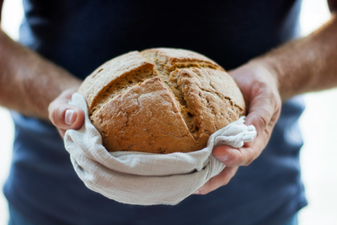
Sometimes, and especially when we go through very difficult life transitions, the past can seem rosier than it was in reality. This appears to be the case with the Israelites, longingly recalling the tasty meat and plentiful bread they enjoyed back in Egypt, despite the misery and distress they endured as an enslaved people. At least Pharaoh didn’t lead them into the desert only for them to starve to death!
True to character, God responds to the Israelites by attending to their needs. They will be given meat to eat in the evening and their fill of bread in the morning. Specifically, each day the people are to go out and gather enough manna for that day. This serves as a daily reminder of their complete dependence on God and of God’s faithful provision and presence in their lives. But it serves another purpose, too. In his Commentary on Exodus, Terence Fretheim writes:
There is to be no hoarding of the gifts of God’s creation, no building of larger and larger barns (Luke 12:18), no anxieties about what they are to eat on the morrow (Luke 12:22-30)….The increasing gap between rich and poor in modern societies is certainly in part due to the hoarding of manna. It witnesses to a failure to recognize that all we have is due to God’s goodness, not our ability to gather manna better than anyone else (186).
God has provided enough food to feed everyone on the planet. And yet, current statistics regarding world hunger are staggering. More than 700 million people experience hunger every day, and over 50 million people are struggling to live in the face of famine.[1] And in the United States alone, 47 million people (including 1 in 5 children) are facing food insecurity.[2]
Yes, it is God who gives bread. But we are called to use our human agency to ensure that the world is fed. There are a myriad of opportunities to do so. We can lend our voice and vote to help shape governmental policy, support non-profit organizations working to end hunger, and donate groceries to a local food shelf.
God’s way into the future with this creation is dependent at least in part on what human beings do and say. This state of affairs brings human responsibility to the forefront of the conversation. Many of us would just as soon leave everything up to God, and God can then be blamed when things go wrong, tragically or otherwise. A way between pessimism in the face of the difficulties on the one hand and a Messiah complex on the other will not always be easy to locate. But God calls human beings to take up these God-given tasks with insight and energy—for the sake of God’s world and all its creatures, indeed for God’s sake (Fretheim, “God and World in the Old Testament: A Relational Theology,” 277-278).
Generous God, all that we have is due to your goodness. Open our hearts and hands so all the world will be fed. Amen.
[1] Bread for the World (bread.org)
[2] Feeding America (feedingamerica.org)