
Today’s author is Prince of Peace member, Scott Tunseth.
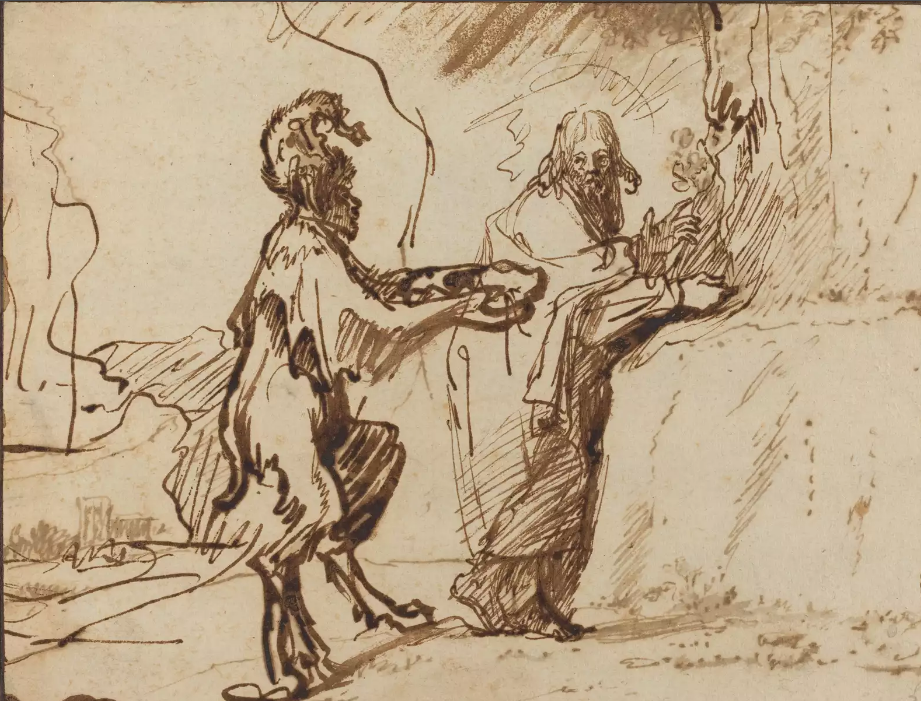
This week we are reading and contemplating Matthew 4:1-17, which includes the temptation of Jesus in the wilderness and the start of his public ministry. It should not surprise us that after Jesus’ is anointed in Baptism (“This is my Son, the Beloved”) the Spirit whisks him away to the wilderness, for forty days of fasting, no less. Remember, this is Matthew talking, and we have already started to understand what Matthew is up to in his Gospel. Matthew’s purpose is to show how Jesus fulfills, extends, incarnates the promises of God to Israel, who wandered in their own wilderness “forty” years before reaching the promised land. Their wandering was a punishment for distrust while Jesus is tempted to prove his trust. If Jesus is Emmanuel—“God is with us” (Matt 1:23)—then let’s see how he passes the temper’s tests.
Test #1
“If you ARE (my emphasis) the Son of God, command these stones to become loaves of bread.”
Jesus hadn’t eaten for forty days, so this temptation to whip up a batch of stone ground bread seems like a reasonable way for Jesus to test his “son-of-godness.” No harm in such a simple show of power. After all, what’s the use of being God if you can’t prove it. Of course, Jesus does later do miraculous things (including turning water to wine in John 2), but now, here in the wilderness, is not the time. Jesus rejects the tempter’s temptation with powerful words that readers of the Hebrew Scriptures would have recognized as Deuteronomy 8:3— “One does not live by bread alone, but by every word that comes from the mouth of God.”
Not only is Jesus a fulfillment of the Scriptures, but he can also quote them, Matthew seems to say. When we pray in the Lord’s Prayer, “Give us this day our daily bread,” Luther in his Small Catechism reminds us that “bread” means everything we need to nourish our bodies and all things that make life meaningful, including friends, family, good government, and even good weather, just to name a few things. We need so many things for a full life, but Jesus highlights just one: God’s word. If you are like me, you spent quite a lot of time worrying about the “things” I need or don’t have, while time with God’s word is often put on the back burner.
Test # 2
The tempter took Jesus up to the top of the temple and said, “If you ARE the son of God, throw yourself down, for it is written (even Satan knows Scripture!), “He will command his angels . . . to bear you up.” The full passage Satan quotes is Psalm 91:11-12, which we also know from its inclusion in the beautiful hymn “On Eagles’ Wings.” There is more at stake in this temptation. The tempter wants to test Jesus’ faith in God just in case Jesus harbored any doubts about who he was or why he was chosen. But Jesus again turns to Scripture to resist, saying, “Again it is written, ‘Do not put the Lord your God to the test’” (Deut 6:16), a reference to Israel’s testing of God by begging for water at the stone of Horeb (Exode 17:1-7).
Jesus has not even begun his public ministry yet, and yet he faces the kind of challenges here in the wilderness that will test him later. We too are no strangers to temptation. That’s why we pray, “Lead us not into temptation” / Save us from the time of trial.” God does not remove us from temptation but promises to be present with us in the midst, saying what he said to the Apostle Paul, “My grace is sufficient for you, for power is made perfect in weakness” (1 Cor 12:9).
Lord God, our strength, the struggle between good and evil rages within and around us, and the devil and all the forces that defy you tempt us with empty promises. Keep us steadfast in your word, and when we fall, raise us again and restore us through your Son, Jesus Christ, our Savior and Lord. Amen (Evangelical Lutheran Worship, p. 26)