
Today’s Author is Nate Youngblood from Every Meal.
There is much about my childhood that I have forgotten. But I vividly remember the verse that was hanging on my closet door when I was between 7 and 10 years old. My best guess is that a parent placed it there due to the summer vacation bible school program at my church. It might have been a memory verse…one of those situations where a child gets a small prize if they do the memory work. I’m sure this process was repeated multiple times a year throughout all my formative years…and yet, this verse stands out more than most (if not all of them) and is still etched into my memory.
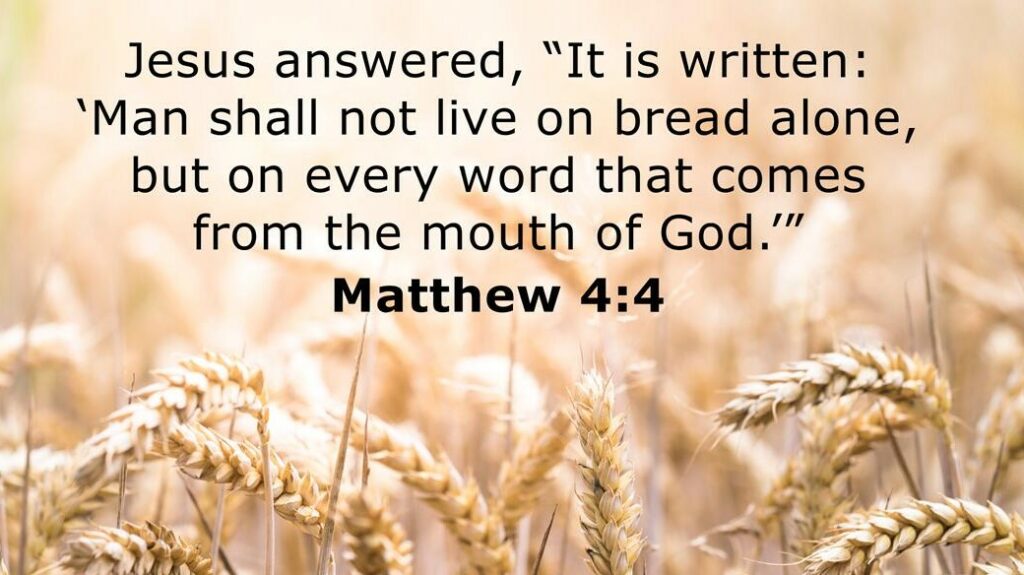
Here I am now, 35 years since I was introduced to the verse and I’m still unpacking Jesus’ words. The context of the short passage is that Jesus is about to start his public ministry. He has stepped into the wilderness and has been fasting for 40 days and 40 nights. In this specific moment, the Tempter has asked Jesus to turn the stones into bread, implying that Jesus is hungry. And Jesus responds with a brief quote from Deuteronomy 8.
Now as a 40-year-old man with three children, a spouse, and a mortgage it can feel like the weight of the world is on my shoulders. I can’t relate to the hunger Jesus felt after fasting for 40 days and 40 nights, but I can relate to the desire for a quick easy solution. That stressor at work that just won’t go away? A quick and easy end to the Covid-19 pandemic? Maybe the end of a family conflict that is always lying just under the surface of every interaction? I think each of us could come up with a list of circumstances or situations where a quick easy solution might seem ideal. And yet in the moment, when Jesus is starving and being challenged to “fix it” for himself, he takes another path. The context of Deuteronomy 8 provides some perspective and teaches us to:
Remember what God has done and how he has provided before
In Deuteronomy 8 God is specifically reminding the Israelites of their experience during the journey from Egypt to the Promised Land. The Lord is challenging them to make sure they do not forget the provision of the Lord, reminding them over and over again “Do not forget.”
I may be alone in this, but I find it incredibly challenging to remember all the ways that the Lord has provided in the past. This is especially true when we are concerned by the urgency of the problem we face. I’m learning that I must actively maintain my memory of what God has done so that I don’t lose touch with the impact of the Lord’s provision. Take a few moments to pause and think about specific ways that the Lord has provided for you and maybe make a note for yourself to remember and reflect on those moments over the next few days.
4 Jesus answered, “It is written: ‘Man shall not live on bread alone, but on every word that comes from the mouth of God.’[a]
Recognize that food is not the only thing we need.
If we have learned anything from the isolation the pandemic, it’s a greater awareness of our emotional and spiritual needs. They aren’t as obvious or immediate as our need for food, but they are vital! In the first few weeks after the pandemic started, I remember the daily commute from my home in Bloomington to our warehouse in Roseville. Every Meal was considered “Essential” and we had rapidly modified our activities so that food could continue to be distributed to children. The highways were empty, so much was unknown regarding the future of the pandemic and our world. I recall being acutely aware that the needs of my family, the team at Every Meal, and the Children we serve were so much greater than my capacity and our collective capacity. Do you remember how you felt in those first few weeks? We were collectively concerned about food (remember how grocery stores had empty shelves as panic buying set in?) but over time we became much more aware of the challenges and effects of isolation.
We found new ways to engage with friends. Three years ago I would have never set up zoom meeting with next-door friends and neighbors! Worship changed, and communities of faith found new ways to connect, worship, and express their faith in spite of all the challenges.
Through all of this, my own awareness (and I don’t believe I’m alone) of my need for the presence of the Holy Spirit became even more clear. Our awareness of our need for the presence of God in our lives is always more acute in a crisis. Thankfully, we can use the things we learn in the crisis and continue to apply them when the storm has passed. My experience has been that no matter my circumstances, I need the “words from the mouth of God” more now than ever before.
My 7-year-old self didn’t really understand what Jesus meant when he said “one doesn’t live by bread alone,” but my 40-year-old self is starting to understand.